
Step 3 · Mix · Homogenize · Mill
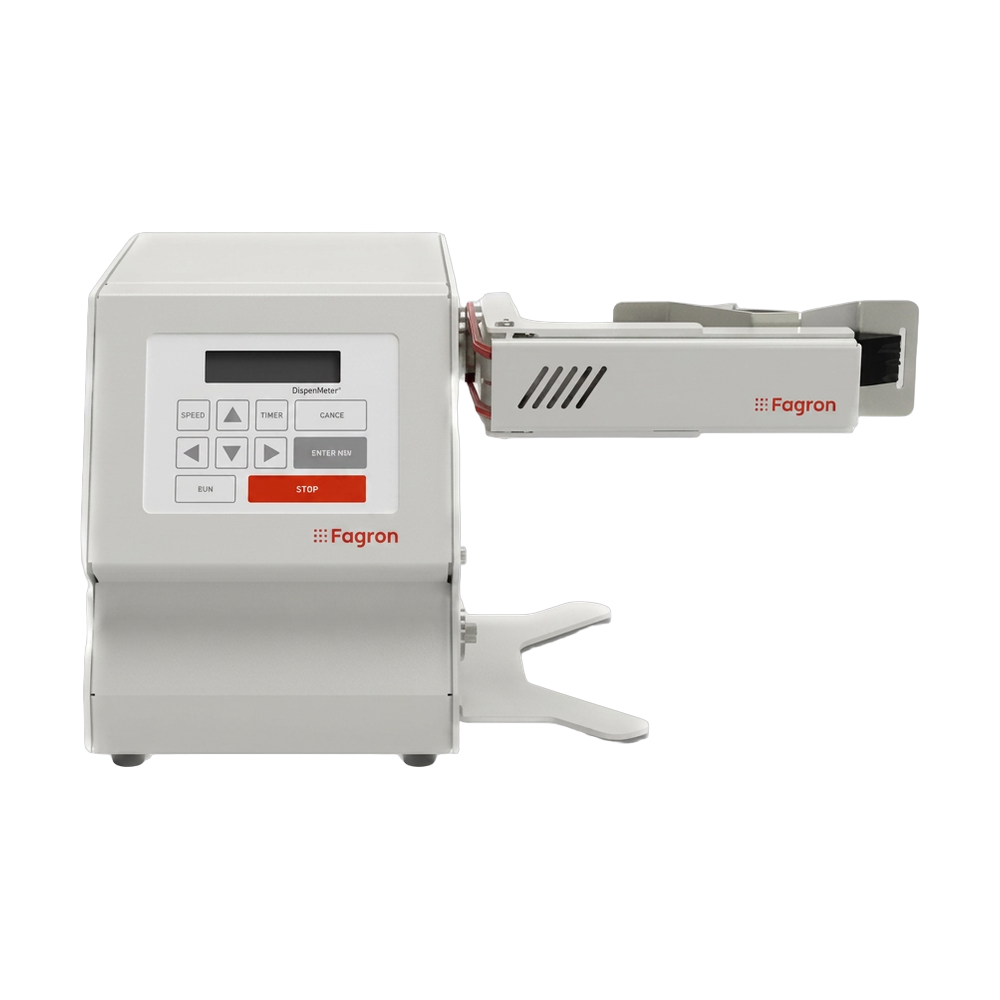
FagronLab™ InvoMatic
3-axis powder and liquid mixing
InvoMatic is an automated mixing system developed to produce highly homogeneous mixtures at controlled time and speed. It works in a 3-axis movement, combining the principles of the oloid and inversion mixing to create a unique 3D cycle that delivers a complete diffusive mix. A digital control lets the pharmacist select mixing cycles to match the characteristics of each formulation, giving easy and efficient reproducibility batch after batch.
How it is used
- Homogenizing powder blends for capsules, sachets and divided powders.
- Blending APIs with excipients and fillers before capsule filling.
- Mixing powders of different granulometry and physical properties, including low-dosage APIs and multicomponent formulations.
- Mixing liquids of different viscosity in a closed vessel, with no risk of cross-contamination.
- Homeopathic preparations and the impregnation of globules and granules, in simple or triple impregnation.
- Mixing takes place inside any vessel already available in the pharmacy — change the vessel and the device is ready for the next cycle, with no cleaning between batches.
- Porcelain or ceramic spheres can be added inside the vessel to avoid particle agglomeration and even out particle size.
Advantages
- Unique 3-axis mixing robotic arm
- Reproducibility and speed
- Automated process
- Validated mixing process
- GMP and GLP compliant
- Safe for hazardous preparations
- Reliability
- Any vessel, any volume
- No cleaning after mixing
Operating parameters
Source: FagronLab™ Formulation Guide. Always follow the parameters for your jar size and API concentration.
Suggested mixing spheres by powder volume
Sphere size increases with batch volume; use larger spheres when granulometry differs between ingredients.
| Powder volume | Number of spheres |
|---|---|
| < 10 g | 2 |
| 10 – 50 g | 2 – 3 |
| 50 – 100 g | 2 – 4 |
| 100 – 250 g | 4 – 6 |
| 250 – 500 g | 6 – 8 |
| 500 – 1000 g | 8 – 10 |
| > 1000 g | 10 – 12 |
Validated mixing cycles (content uniformity study)
Three powder mixtures — low-dosage ingredients, ingredients of differing granulometry, and a multicomponent formulation — were mixed across every combination below. All conditions produced homogeneous mixtures with adequate dose uniformity, even at the shortest mixing time.
| Parameter | Conditions tested |
|---|---|
| Mixing time | 2, 5 and 8 minutes |
| Mixing speed | 10, 50 and 100 RPM |
| Formulations | Low-dosage API, mixed granulometry, multicomponent |
| Outcome | Homogeneous mixture and adequate dose uniformity in all cycles |
Comparative content uniformity — InvoMatic vs. alternative methods
Representative capsule assay values (% of label claim) for a finasteride formulation, mixed under identical conditions with a V/Y-shaped mixer, the InvoMatic 3-axis mixer and the manual plastic bag technique. AV = Acceptance Value (Ref. USP).
| Capsule | V mixer | InvoMatic (3-axis) | Manual bag |
|---|---|---|---|
| 1 | 97 | 95 | 98 |
| 2 | 98 | 95 | 97 |
| 3 | 96 | 95 | 96 |
| 4 | 95 | 93 | 87 |
| 5 | 97 | 96 | 85 |
| 6 | 97 | 96 | 91 |
| 7 | 97 | 96 | 91 |
| 8 | 94 | 96 | 87 |
| 9 | 93 | 97 | 87 |
| 10 | 97 | 95 | 88 |
What it delivers
Homogeneous mixtures every time
Controlled time and speed remove operator variability, so content uniformity no longer depends on technique.
Safe with hazardous preparations
Mixing happens inside a closed vessel, keeping powders contained and eliminating cross-contamination.
No cleaning between batches
Nothing enters the mixture — swap the vessel and the next cycle can start immediately.
Gentle on sensitive ingredients
Diffusive mixing has no internal rotor and generates no heat, protecting shear- and thermo-sensitive APIs.
The oloid concept
The oloid is a three-dimensional geometric object discovered by the German mathematician Paul Schatz in 1929. It is the convex hull of two circles standing perpendicular to each other and, although its shape is curved, it rolls in a perfectly straight line, creating a unique inversion motion.
The oloid-like motion generated during the mixing cycle distributes materials evenly, with proper homogenization and particle overlay in a rhythmic, symmetric circular movement. Combined with a robotic arm, this gives InvoMatic its 3-axis structure and its diffusive mixing performance.
The diffusive mixing method
Diffusive mixing moves particles randomly inside a vessel under the influence of gravity, causing them to roll to the opposite side and producing a homogeneous mixture without an internal rotor.
Diffusive mixers are a good solution for shear-sensitive ingredients that can be damaged by the rotors of convective mixers, and they generate no temperature during the cycle — an advantage for thermo-sensitive ingredients. Traditional V- and Y-shaped blenders work on the same principle but are built for large-scale production and require high-standard cleaning after every use, which makes them unfavorable for small compounded batches.
Why powder mixing is the critical step
Powder mixing is the most common and one of the most challenging operations in the compounding pharmacy. A single pharmaceutical powder mixture can contain up to 20 different ingredients before it meets acceptable quality standards for the final product.
Flow characteristics, particle size and shape, density, cohesivity, hygroscopicity and hardness all influence mixing efficiency. When these are not accounted for, particles agglomerate and ingredients distribute unevenly, resulting in a lack of dose uniformity in the finished formulation.
Comparative performance
A comparative study evaluated homogenization efficiency between InvoMatic, a Y-shaped mixer and the manual plastic bag technique, with all methods run under identical mixing conditions for each formulation.
InvoMatic was superior or at least comparable to the alternative methods — most clearly against manual mixing — confirming that automation increases the reliability of the mixing process. Formulations tested included finasteride capsules; vitamin B12 and folic acid capsules; and copper chelate, magnesium citrate and zinc chelate capsules.
Specifications
- Mixing motion
- 3-axis oloid / inversion movement via robotic arm
- Mixing speed
- 0 – 100 RPM
- Mixing time
- 0 – 99 minutes
- Vessel capacity
- 30 mL – 1,000 mL (average)
- Vessels
- Any vessel available in the pharmacy
- Mixing type
- Diffusive (non-segregating rotor-free)
- Suitable for
- Powders, liquids, homeopathic preparations, globule and granule impregnation
- Compliance
- GMP and GLP compliant, validated mixing process

Questions about equipment?
Contact your Fagron Equipment Representative, Nicholas Fournarakis
Nicholas can help with pricing, demos, installation, training and service for any FagronLab™ instrument or workflow.
Nicholas.Fournarakis@fagron.usContact Fagron
Have a Question? We’re Here to Help.
Contact our team for support with ingredients, equipment, formulations, education, ordering or other compounding needs.
Personalized support
How Can We Support You?
Tell us what you are looking for and a member of the Fagron team will connect you with the appropriate product, service or educational resource.
Email us
Responsive support
A member of our team will review your request and follow up.
Personalized guidance
Product, formulation, equipment and education support.
201 W. 5th Street, Suite 1250, Austin TX 78701