
Step 3 · Mix · Homogenize · Mill
FagronLab™ WetMill Compact
Wet milling for suspensions
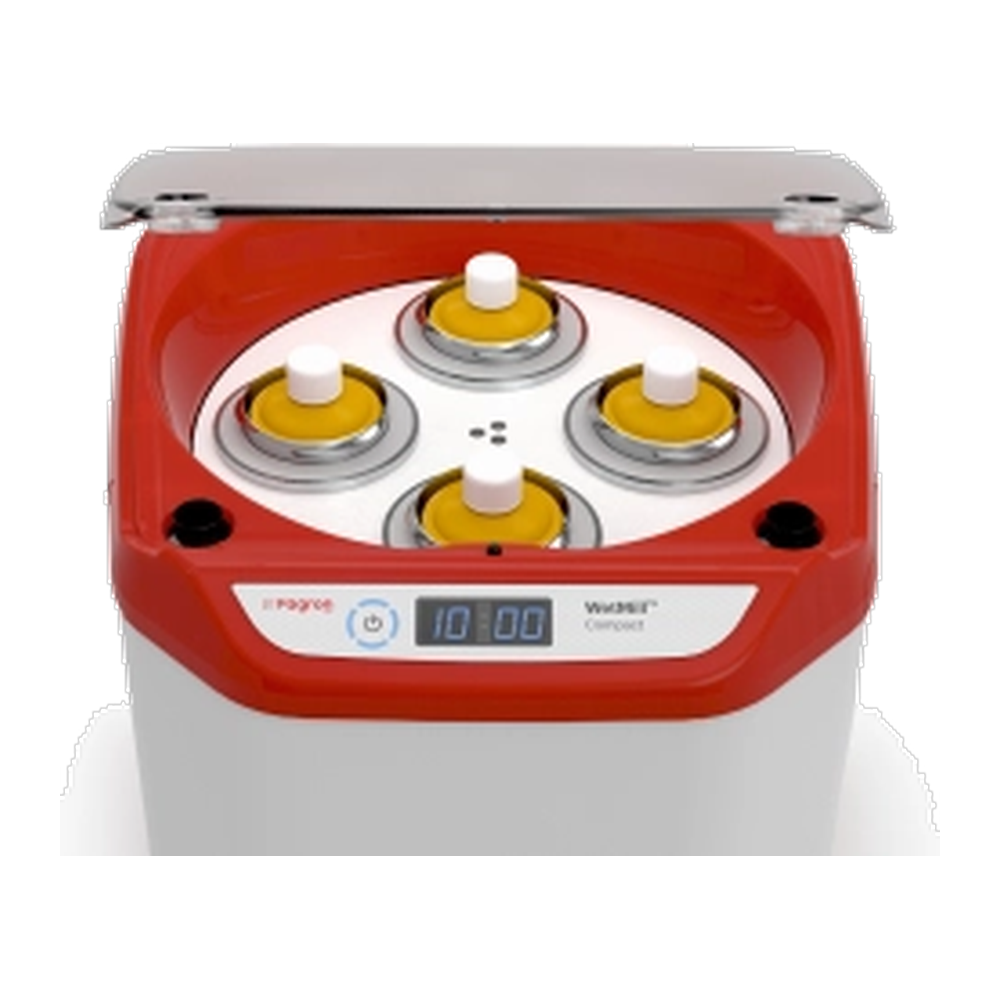
An automated planetary colloidal milling system that converts tablets, whole capsules and bulk powders into homogeneous oral liquid suspensions inside a sealed, disposable milling bottle. The patented bottles have an abrasive interior surface that, combined with a high-speed planetary rotation cycle, reproduces the rotor-stator colloid milling used in pharmaceutical manufacturing at pharmacy scale. Because the bottle is used to compound, store and dispense the medication, the preparation is never transferred, nothing is lost between vessels and no cleaning is required after the cycle.
How it is used
- Liquid suspensions and colloidal solutions from insoluble powders, tablets or capsules.
- Extemporaneous oral liquids for pediatric, geriatric, dysphagic and enterally fed patients who cannot swallow solid dosage forms.
- Enclosed, cross-contamination-free compounding of hazardous drugs, drugs with a narrow margin of safety and highly allergenic substances.
- Bottles are loaded with equal weights facing each other; a water-filled counterweight bottle balances an odd load.
- A second 10-minute cycle homogenizes the batch after viscosity agents, flavoring, preservatives or SyrSpend® SF are added.
Advantages
- 3-in-1 disposable bottle: compound, store and dispense in the same container
- Fine, uniform particle size that resists sedimentation and keeps feeding tubes patent
- Validated cross-contamination-free, closed system for hazardous drug handling
- Four formulations in about 10 minutes versus roughly 30 minutes for one manual grind
- Reproducible, automated cycles that remove the variability of manual grinding
- Compact benchtop footprint — colloid milling without industrial-scale machinery
Operating parameters
Source: FagronLab™ Formulation Guide. Always follow the parameters for your jar size and API concentration.
WetMill Compact cycle times
Set the cycle according to the ingredients used in the formulation.
| Formulation | Cycle time |
|---|---|
| Powder + water | 10 minutes |
| Tablet / powder + water | 12 minutes |
| Tablet / capsule + water + various diluents | 32–46 minutes |
| Homogenizing after excipient addition | 10 minutes |
Validation and content-uniformity studies
| Study | Method | Result |
|---|---|---|
| Aerosolized powders (methylene blue, rifampin) | Ten consecutive 10-minute cycles, device swabbed with methanol | No compound detected on bottles or device — no cross-contamination risk |
| Thiamine HCl closure integrity | Four bottles (in triplicate), 25 mg/mL, 30 minutes total; HPLC limit 0.02 µg/mL | No thiamine detected in any sample |
| Clonidine HCl 20 µg/mL for neonates (tablets) | 10-minute cycle in water | Content uniformity within 1% of label claim (%RSD 0.84); stability within 5% at room temperature |
| Tacrolimus 1 mg/mL (whole capsules) | 32-minute cycle | Dose uniformity within 7% of label claim (%RSD 5.5); stability within 3% |
| Hydroxyurea 100 mg/mL (whole capsules) | 32-minute cycle | Dose uniformity within 2% of label claim (%RSD 1.1); stability under 8% |
| Paracetamol 50 mg/mL with SyrSpend® SF PH4 dry | Full 10-minute cycle, 6.5 g SyrSpend® SF PH4 dry added and shaken 1 minute; 8 samples, resuspended at 14 days | Content uniformity within 5% of label claim (VA 6.7) |
| Rifampin suspensions through an 8F nasogastric tube | Wet milling vs. mortar and pestle, injectability measured every 24 hours for 7 days | Tube patency maintained for 7 days with suspension vehicles; mortar-and-pestle preparations blocked the tube |
Medications tested with the WetMill Compact
Up to 100 tablets can be milled in a single bottle, depending on tablet size and strength.
| Azathioprine (from tablets) | Hydroxyurea (from whole capsules) | Sildenafil |
| Amlodipine (from tablets) | Lisinopril | Spironolactone (from tablets) |
| Baclofen | 6-Mercaptopurine (from tablets) | Tacrolimus (from whole capsules) |
| Clonidine | Methotrexate (from tablets) | Topiramate (from tablets) |
| Dexamethasone | Metronidazole | Ursodiol |
| Haloperidol | Rifampin |
What it delivers
Safety for the patient
A single bottle is used for compounding, storage and dispensing, so cross-contamination risk is eliminated and no extra cleaning step is required.
Safety for the pharmacist
Aerosolization is contained inside sealed bottles throughout the entire cycle, avoiding direct exposure to hazardous, cytotoxic or highly allergenic substances.
Tube patency
Rifampin suspensions prepared by wet milling flowed through an 8F nasogastric tube for seven days without blockage, while mortar-and-pestle preparations clogged within days.
Time savings
Manual grinding can take up to 30 minutes for a single formulation; the WetMill Compact prepares four formulations in a 10-minute cycle.
The industry inside a bottle
Colloid mills reduce particle size on the rotor-stator principle: a rotor turns at high speed and applies hydraulic shear that breaks down structure and disperses particles into the liquid. They are highly effective but large, heavy, expensive and limited to one preparation at a time — impractical for a compounding pharmacy.
The WetMill Compact miniaturizes that principle. The patented milling bottles carry an abrasive interior surface that, driven by a high-speed planetary rotation cycle, produces fine, uniform and homogeneous suspensions — up to four preparations at once on a pharmacy bench.
Why wet milling instead of dry grinding
Extemporaneous oral liquids are traditionally prepared by reducing tablets or capsule contents with a mortar and pestle, a grinder, or by mashing tablets in a plastic bag. These techniques lack reproducibility and produce uneven particle sizes that are poorly suited to physically stable liquid preparations and can precipitate into crystals that block nasogastric tubes.
Wet milling reduces the particles directly in the liquid inside a closed bottle, giving smaller, more uniform particles with greater resistance to sedimentation — and removing the cleaning burden that follows manual grinding of hazardous drugs.
Compounding with hazardous drugs
NIOSH classifies a drug as hazardous when it shows genotoxicity, carcinogenicity, teratogenicity, or serious organ or other toxicity at low doses. Manual compounding of these drugs generates airborne particles, and repeated workplace exposure has been associated with skin rash, adverse reproductive outcomes, ocular damage, flu-like symptoms, headache and even leukemia and other cancers.
Closure integrity studies using methylene blue, rifampin and thiamine HCl detected no trace of the model compounds on the bottles or on the interior or exterior of the device, confirming that the WetMill Compact compounds hazardous medication more safely than manual techniques.
Vehicles and adjuvants
Water transfers energy most efficiently during milling and is the recommended diluent. After milling, a suspending agent should be added so the preparation suspends properly and doses consistently.
SyrSpend® SF PH4 NEO (preserved), SyrSpend® SF PH4 dry and SyrSpend® SF Alka are globally available vehicles with proven physical-chemical stability across more than 100 APIs in 150 formulations. Combining WetMill Compact milling with SyrSpend® SF delivers validated stability and content uniformity in the finished suspension.
Specifications
- Technology
- Planetary colloidal wet milling with patented abrasive-surface bottles
- Capacity
- Up to 4 different formulations per cycle
- Cycle time
- 10 minutes (powder + water) to 46 minutes (tablets/capsules + diluents)
- Milling load
- Up to 100 tablets in one bottle, depending on tablet size and strength
- Containment
- Fully enclosed system; closure integrity validated by HPLC and dye-tracer studies
- Bottles
- Disposable 3-in-1 milling bottles — compound, store and dispense
- Recommended diluent
- Water, followed by SyrSpend® SF PH4 NEO, SyrSpend® SF PH4 dry or SyrSpend® SF Alka as suspending vehicle
- Cleaning
- None required — no shared contact parts between formulations

Questions about equipment?
Contact your Fagron Equipment Representative, Nicholas Fournarakis
Nicholas can help with pricing, demos, installation, training and service for any FagronLab™ instrument or workflow.
Nicholas.Fournarakis@fagron.usContact Fagron
Have a Question? We’re Here to Help.
Contact our team for support with ingredients, equipment, formulations, education, ordering or other compounding needs.
Personalized support
How Can We Support You?
Tell us what you are looking for and a member of the Fagron team will connect you with the appropriate product, service or educational resource.
Email us
Responsive support
A member of our team will review your request and follow up.
Personalized guidance
Product, formulation, equipment and education support.
201 W. 5th Street, Suite 1250, Austin TX 78701